 ZANSHIN
Sign in
Second-order Greek · ∂²V/∂S∂t
Charm: how delta decays as time passes
Charm, also called delta decay, is the change in an option's delta as time passes with everything else held still. For same-day options it is one of the largest flows in the market.
The formula
d₁ = [ ln(S/K) + (r + σ²/2)·T ] / (σ√T)
d₂ = d₁ − σ√T
Charm = −∂Δ/∂T = φ(d₁)·d₂ / (2T) (r = 0, per unit of time passing)
Black-Scholes, European options, no dividends. S spot, K strike, T years to expiry, r the risk-free rate, σ implied volatility, N(·) the standard normal CDF and φ(·) its density.
With r = 0 it's the same for calls and puts. For an out-of-the-money call (d₂ < 0) charm is negative: as time passes, its delta bleeds toward 0. For an in-the-money call it's positive: delta drifts toward 1. Time pushes every delta toward where the option will finish.
Why 0DTE makes charm matter
The 1/T in the formula means charm grows sharply into expiry. On a same-day option, deltas can change a lot over an hour with price standing still. Dealers hedged against those deltas have to trade as they decay, and that flow has a direction set by where the open interest sits relative to price.
The charm surface
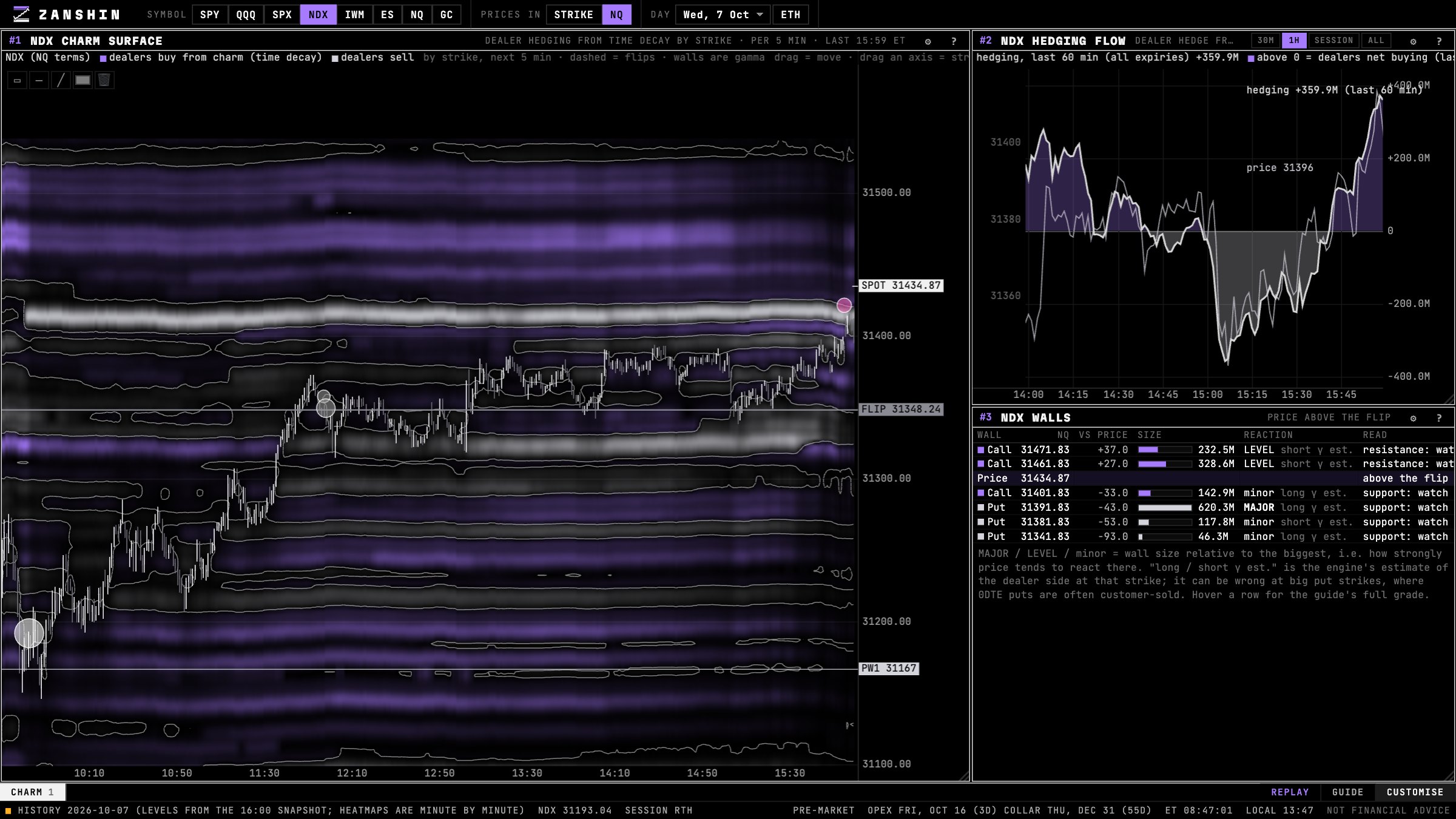
Zanshin Flow computes each strike's dealer charm every minute and turns it into the dollars dealers would buy or sell from time decay alone over the next five minutes, smoothed into a field and contoured where it flips sign. It's after the TRACE-style charm view some desks use, drawn against price so you can see which strikes are supplying flow and which direction.
A caveat
Whether the charm field predicts drift is a separate question from what it describes. Treat the surface as a picture of the book's time-decay pressure, not a forecast.
Questions
What is charm in options?
Why does charm matter for 0DTE options?
Is charm positive or negative?
Not financial advice. This article explains how options and dealer hedging work. It is not a recommendation to buy or sell anything.