 ZANSHIN
Sign in
Second-order Greek · ∂²V/∂S∂σ
Vanna: how delta changes when implied volatility moves
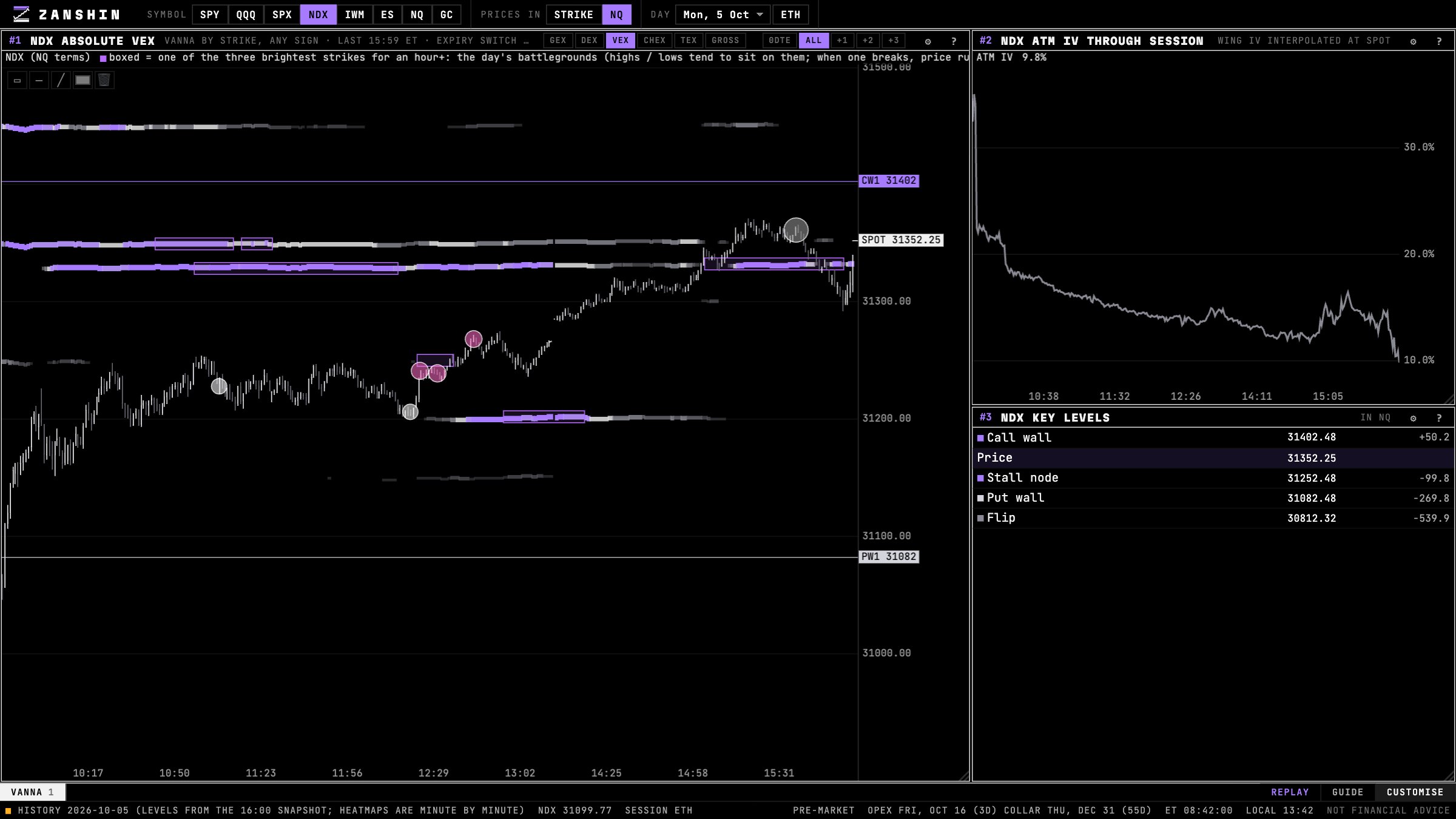
Vanna is the change in delta for a change in implied volatility, and equally the change in vega for a change in spot. When implied vol moves across a whole options book, vanna turns that move into buying or selling.
The formula
d₁ = [ ln(S/K) + (r + σ²/2)·T ] / (σ√T)
d₂ = d₁ − σ√T
Vanna = ∂Δ/∂σ = −φ(d₁)·d₂ / σ
Black-Scholes, European options, no dividends. S spot, K strike, T years to expiry, r the risk-free rate, σ implied volatility, N(·) the standard normal CDF and φ(·) its density.
It's the same for calls and puts. It's positive where d₂ < 0, roughly strikes above spot (out-of-the-money calls, in-the-money puts), and negative where d₂ > 0, strikes below spot. In words: raising implied vol pulls out-of-the-money call deltas up and in-the-money call deltas down, toward the middle.
Vanna flows
If dealers hold a book with net vanna V (in delta per unit of vol), a change Δσ in implied volatility shifts their delta by V·Δσ, and they trade the opposite to stay hedged. The common story: after an event passes, implied vol falls, dealer deltas shift, and their re-hedging buys the index. That's the "vanna rally" you'll hear about around FOMC or OPEX.
What we found when we tested it
On our archive of seven sessions across SPX, SPY, ES, NDX, QQQ, NQ and IWM, a "vanna flow" signal (dealer vanna × the 30-minute change in ATM IV) did correlate with the next 30 minutes' return, but net dealer vanna was positive 88% of the time, so the signal was the IV change in disguise. Holding the IV change fixed, vanna's own contribution was 0.00 on held-out days. Small sample; we'll rerun it as the archive grows.
Questions
What is a vanna rally?
Is vanna the same for calls and puts?
Is vanna ∂Δ/∂σ or ∂vega/∂S?
Not financial advice. This article explains how options and dealer hedging work. It is not a recommendation to buy or sell anything.