 ZANSHIN
Sign in
Dealer positioning
Dealer hedging: how market makers turn options into flow
Market makers sell options to the public and hedge the risk, mostly by trading the underlying or its futures. Every Greek that moves their delta forces another trade, and summed across the market those trades are real buying and selling.
Delta hedging in one paragraph
Sell a call with delta 0.40 on 100 shares and you're short 40 shares of exposure, so you buy 40 shares. Now you're flat, for a moment. Everything that changes the option's delta unflattens you, and you trade again.
What forces the next trade
- Price, through gamma: the bigger the move and the gamma, the bigger the re-hedge. Its sign decides whether hedging leans against the move or chases it.
- Time, through charm: deltas decay with the clock, hugely so for same-day options.
- Implied volatility, through vanna: a move in IV shifts deltas across the book.
- New trades: every option a customer buys or sells hands the dealer a new delta to hedge immediately.
Estimating hedging flow from the tape
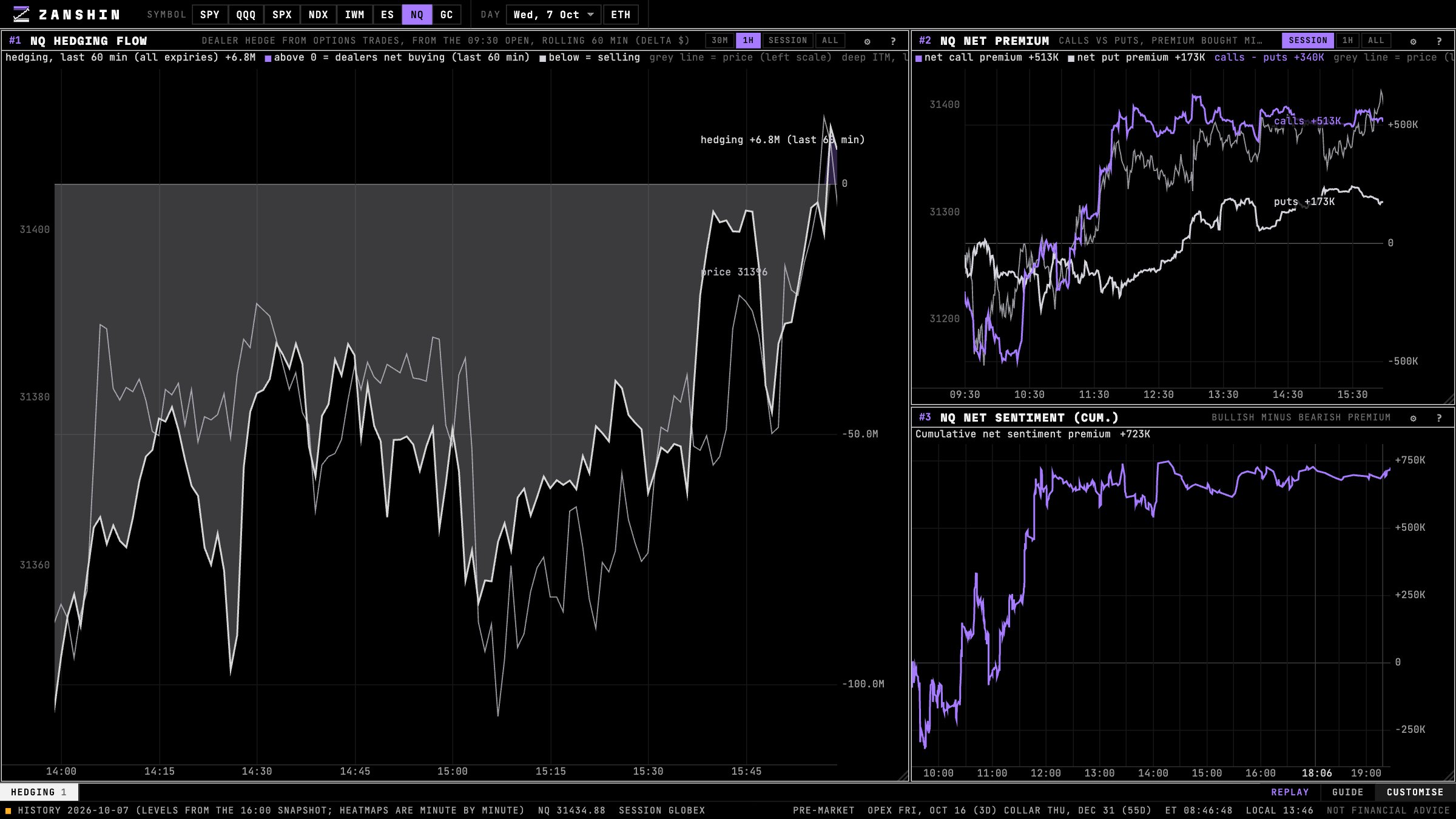
The last item is the one you can watch live. Sign each options print by its aggressor side, compute the delta it hands the dealer, and keep a running total: that's what dealers must buy or sell to stay hedged. Zanshin Flow's hedging-flow window does this for every sided print, HIRO-style, and draws it against price.
The assumptions
An aggressor side says who crossed the spread, not whether a trade opened or closed a position, and not whether the counterparty was a market maker. Every hedging-flow estimate rests on those assumptions; treat it as an estimate of pressure, not a record of trades.
Questions
Why do market makers delta hedge?
What is dealer hedging flow?
How can you estimate hedging flow?
Not financial advice. This article explains how options and dealer hedging work. It is not a recommendation to buy or sell anything.