 ZANSHIN
Sign in
Second-order Greek · ∂²V/∂σ²
Vomma (volga): the convexity of an option to implied volatility
Vomma is the change in vega for a change in implied volatility. An option with positive vomma gains vega as vol rises, so its value is convex in volatility the way gamma makes it convex in price.
The formula
d₁ = [ ln(S/K) + (r + σ²/2)·T ] / (σ√T)
d₂ = d₁ − σ√T
Vomma = ∂Vega/∂σ = Vega·d₁·d₂ / σ
Black-Scholes, European options, no dividends. S spot, K strike, T years to expiry, r the risk-free rate, σ implied volatility, N(·) the standard normal CDF and φ(·) its density.
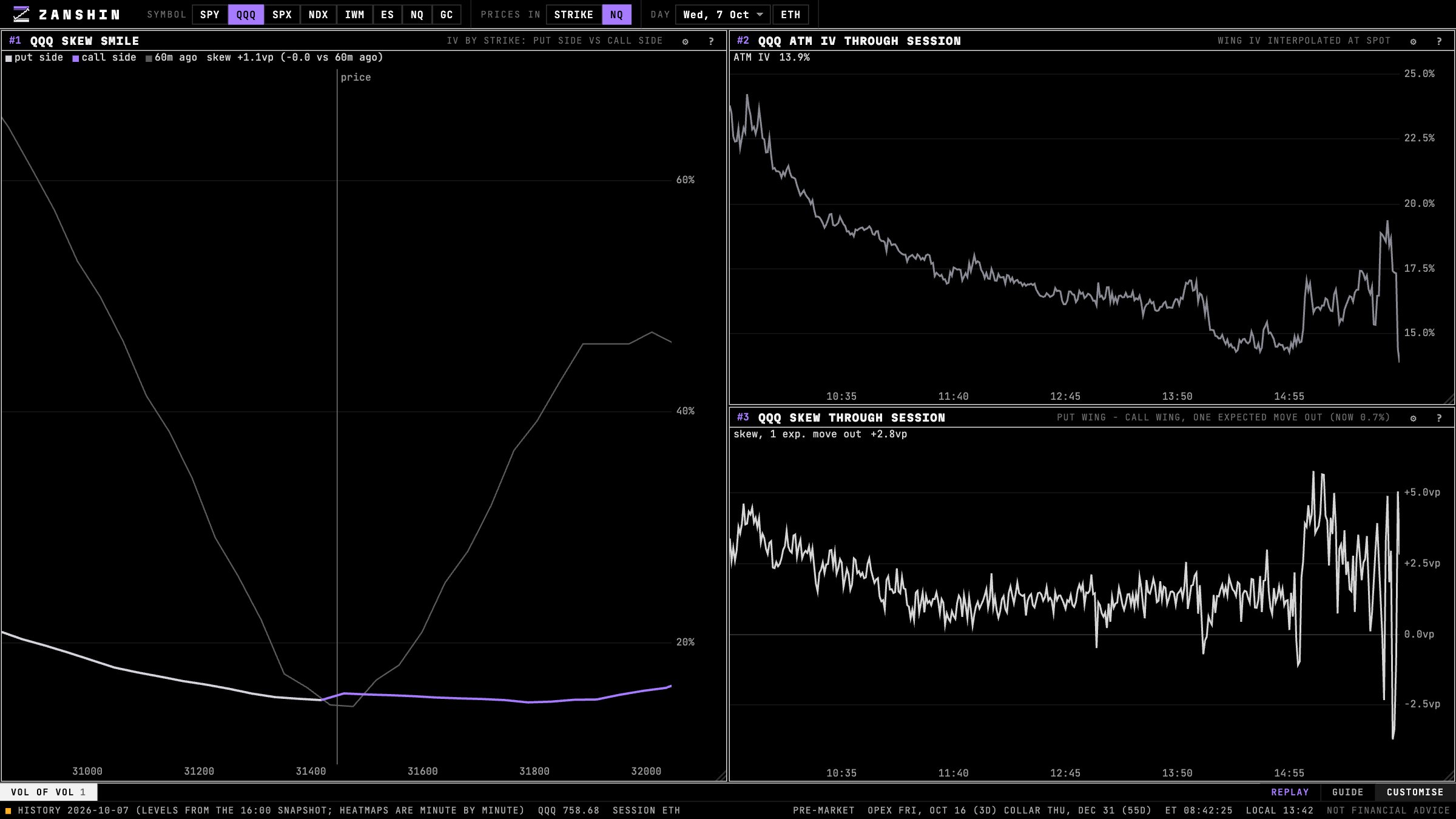
At the money d₁·d₂ is close to zero, so vomma is small. It's positive and largest in the out-of-the-money wings, where d₁ and d₂ share a sign.
Why it matters
A long position in out-of-the-money options is long vomma: if implied vol rises, those options gain vega, so they gain faster on any further rise. That convexity is worth paying for, and it's one reason the volatility smile has wings: options far from the money are priced at higher implied vols than Black-Scholes with one flat volatility would give.
Its family
Vomma is to vega what gamma is to delta. Its own derivative is ultima; its cross-derivatives with price are vanna (via delta) and zomma (via gamma).
Questions
Is vomma the same as volga?
Where is vomma highest?
Why does vomma relate to the volatility smile?
Not financial advice. This article explains how options and dealer hedging work. It is not a recommendation to buy or sell anything.