 ZANSHIN
Sign in
Third-order Greek · ∂³V/∂S²∂t
Color: how gamma changes as time passes
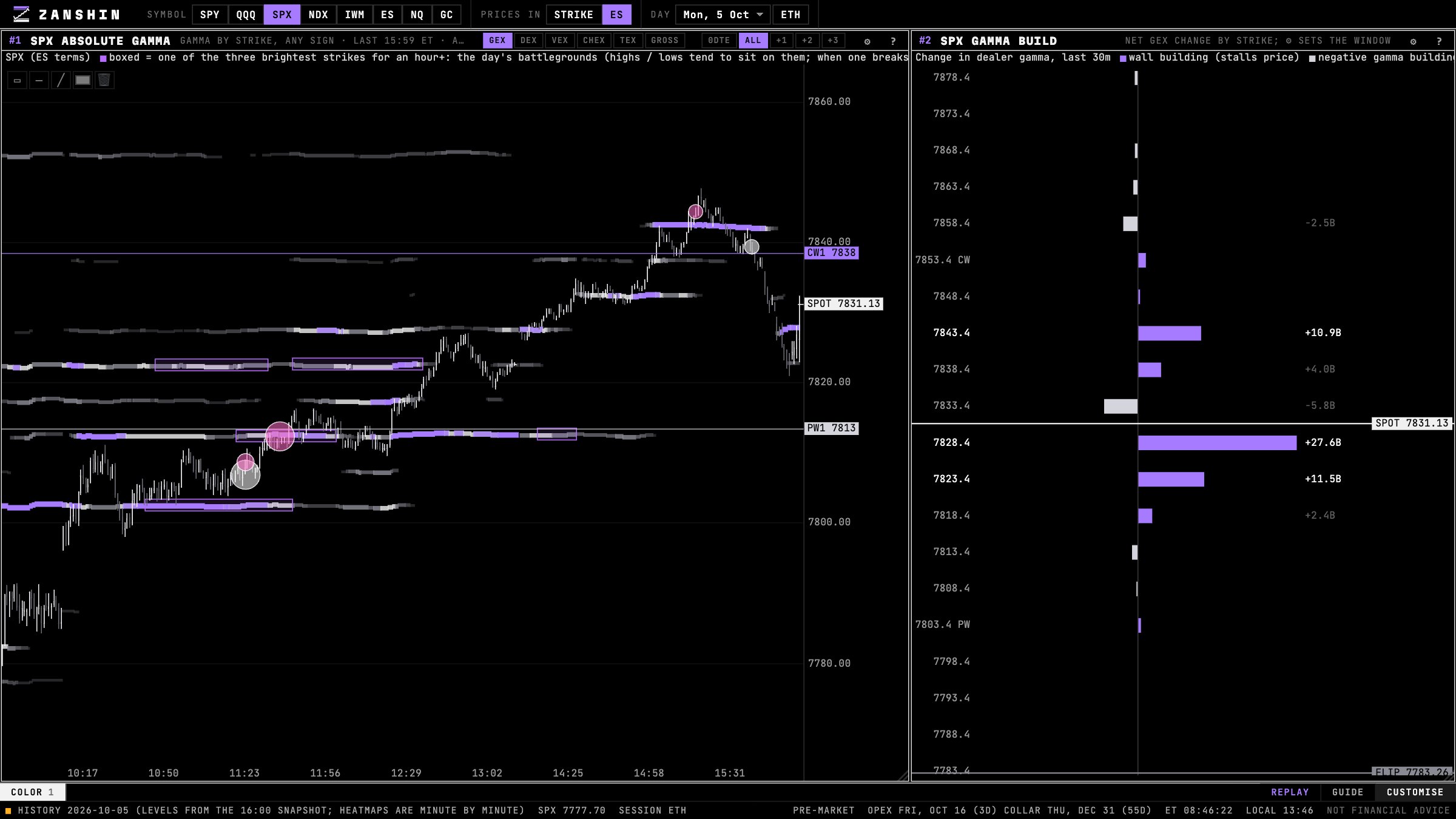
Color, also called gamma decay or DgammaDtime, is the change in gamma as time passes. It's why the gamma map of a same-day book keeps sharpening through the afternoon.
The formula
d₁ = [ ln(S/K) + (r + σ²/2)·T ] / (σ√T)
d₂ = d₁ − σ√T
Color = −∂Γ/∂T = Γ·(1 − d₁·d₂) / (2T) (r = 0, per unit of time passing)
Black-Scholes, European options, no dividends. S spot, K strike, T years to expiry, r the risk-free rate, σ implied volatility, N(·) the standard normal CDF and φ(·) its density.
Sign conventions differ between references: some quote ∂Γ/∂T (time to expiry growing), which flips the sign. Here, positive color means gamma increases as the clock runs.
What it says
Near the money d₁·d₂ is close to zero, so color is positive: gamma there grows as expiry approaches. Far from the money d₁·d₂ exceeds 1 and color turns negative: those strikes lose gamma. Time concentrates gamma onto the strikes near price, which is why a 0DTE gamma map looks diffuse in the morning and sharp by the close.
Do they predict anything?
We tested speed, color and zomma, plus four fourth-order exposures (∂⁴V/∂S⁴, ∂⁴V/∂S³∂t, ∂⁴V/∂S²∂σ², ∂⁴V/∂S³∂σ), computed from the dealer book every minute, against the next 30 minutes' realised volatility and move, on seven archived sessions across SPX, SPY, ES, NDX, QQQ, NQ and IWM. Trained on five days, checked on two unseen ones, controlling for the last 30 minutes' realised volatility, gamma and time of day: none added anything, and the best result on training reversed on the unseen days. Small sample, correlated symbols; we rerun it as the archive grows.
Questions
What is the color Greek?
Why does at-the-money gamma increase near expiry?
Why do sources disagree on color's sign?
Not financial advice. This article explains how options and dealer hedging work. It is not a recommendation to buy or sell anything.