 ZANSHIN
Sign in
First-order Greek · ∂V/∂t
Theta: what time costs an option
Theta is the change in an option's value as one unit of time passes, usually quoted per day. For an option holder it's almost always negative: time is what you pay for convexity.
The formula
d₁ = [ ln(S/K) + (r + σ²/2)·T ] / (σ√T)
d₂ = d₁ − σ√T
Θcall = −S·φ(d₁)·σ / (2√T) − r·K·e−rT·N(d₂)
Θput = −S·φ(d₁)·σ / (2√T) + r·K·e−rT·N(−d₂)
Black-Scholes, European options, no dividends. S spot, K strike, T years to expiry, r the risk-free rate, σ implied volatility, N(·) the standard normal CDF and φ(·) its density.
That's per year; divide by 365 for calendar-day decay (or 252 if you count trading days). The first term, the volatility term, dominates for short-dated options.
Decay isn't linear
An at-the-money option loses value roughly in proportion to √T, so the last days, and on expiry day the last hours, cost the most. That's why 0DTE premium can melt within a session if price sits still.
The theta-gamma trade-off
For a delta-hedged option, theta and gamma are two sides of one bet. Under Black-Scholes, Θ + ½·σ²·S²·Γ = r·(V − S·Δ). With rates near zero, a long-gamma position pays theta every day and earns it back only if realised movement beats what implied volatility priced in.
Dealer theta
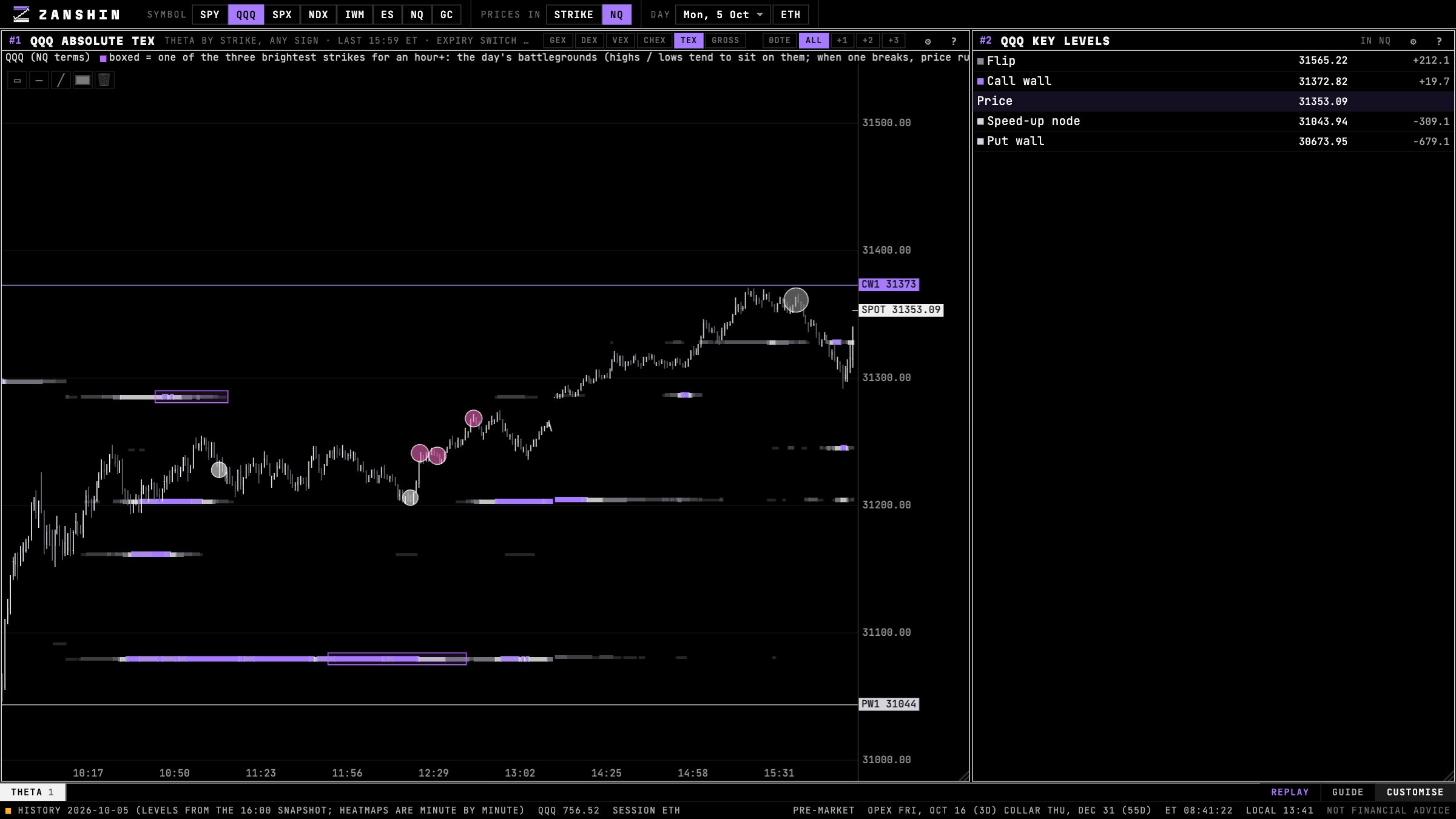
Summed across the dealer book, theta tells you how much premium market makers collect (or pay) per day by holding their inventory. Zanshin Flow reports it as TEX in the Exposures window. The flow that moves price from time decay is a different Greek: charm.
Questions
Why does theta speed up near expiration?
Is theta always negative?
How do I convert annual theta to daily?
Not financial advice. This article explains how options and dealer hedging work. It is not a recommendation to buy or sell anything.