 ZANSHIN
Sign in
Overview
The option Greeks, explained: one map from delta to ultima
The Greeks are partial derivatives of an option's price. Each one answers a single question: if spot, time or implied volatility moves a little, how much does the option's value, or one of its other Greeks, change?
Three things an option is sensitive to
An option's price depends on the underlying's price (S), the time left (T) and the implied volatility (σ) the market assigns it. Interest rates matter too, a little. Every Greek is a derivative of the price with respect to one or more of these, and the order of a Greek is how many derivatives deep it goes.
| Greek | Order | Derivative | The question it answers |
|---|---|---|---|
| Delta | 1 | ∂V/∂S | How much does the option move per $1 in the underlying? |
| Theta | 1 | ∂V/∂t | How much value bleeds away per day? |
| Vega | 1 | ∂V/∂σ | How much does it gain per point of implied vol? |
| Rho | 1 | ∂V/∂r | How much does it care about interest rates? |
| Gamma | 2 | ∂²V/∂S² | How fast does delta change as price moves? |
| Vanna | 2 | ∂²V/∂S∂σ | How does delta change when implied vol moves? |
| Charm | 2 | ∂²V/∂S∂t | How does delta drift as time passes? |
| Vomma | 2 | ∂²V/∂σ² | How does vega change when implied vol moves? |
| Speed | 3 | ∂³V/∂S³ | How fast does gamma change as price moves? |
| Color | 3 | ∂³V/∂S²∂t | How does gamma change as time passes? |
| Zomma | 3 | ∂³V/∂S²∂σ | How does gamma change when implied vol moves? |
| Ultima | 3 | ∂³V/∂σ³ | How does vomma change when implied vol moves? |
Why traders who never hold options watch them anyway
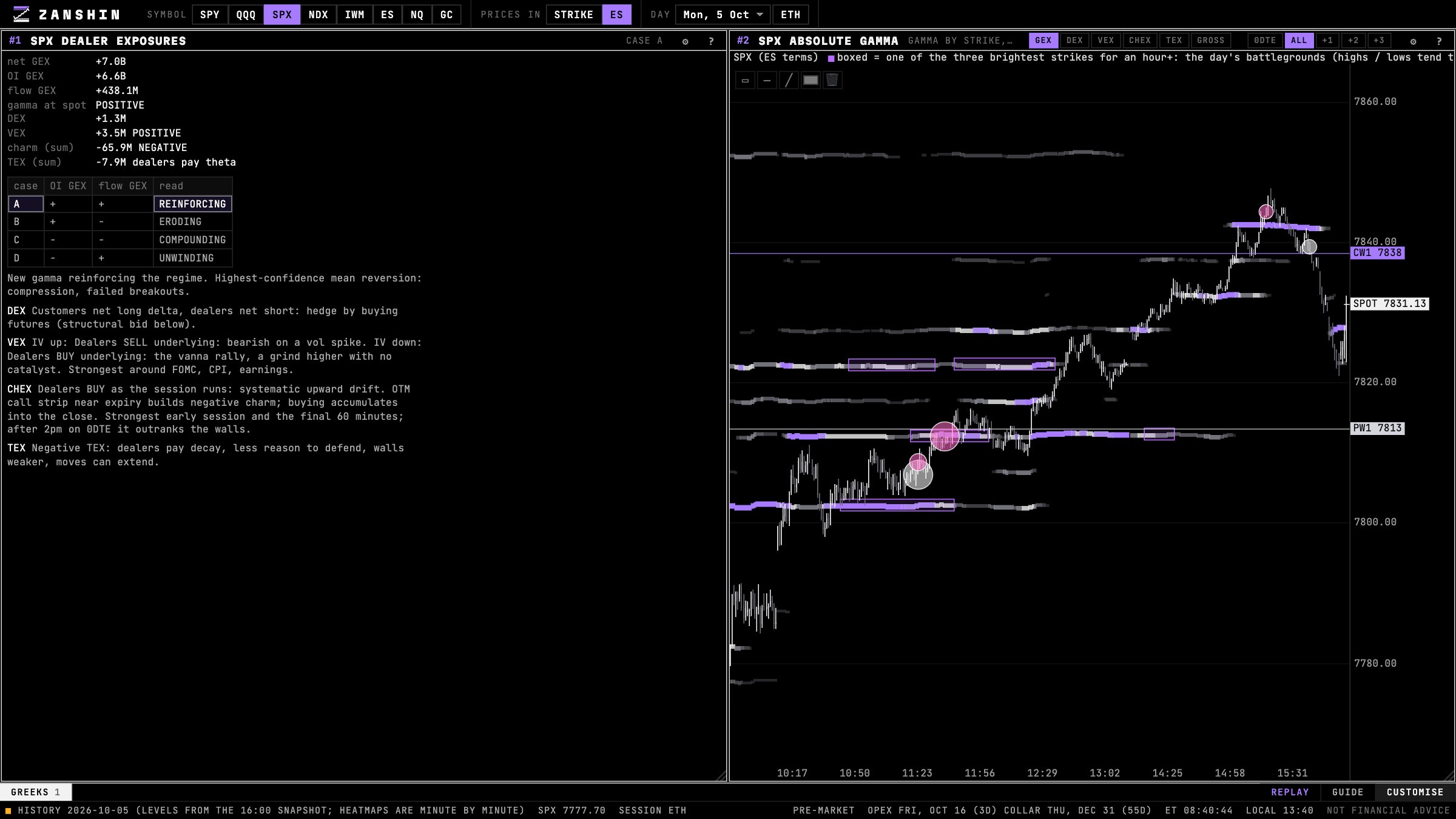
Market makers sell options to the public and hedge the risk, mostly by trading the underlying or its futures. Their hedging depends on the Greeks of the whole book they hold, not on one contract. When that book is large, its Greeks turn into real buying and selling: gamma exposure decides whether hedging leans against moves or chases them, charm turns the passage of time into flow, and vanna does the same for changes in implied volatility. That's what Zanshin Flow computes and draws, strike by strike, every minute.
A word on what the Greeks don't do
Greeks describe sensitivities at an instant under a model. They are not forecasts. We test dealer-positioning ideas against our own archive, and most fail when used alone.
Questions
What are the five main option Greeks?
What is a higher-order Greek?
Which Greeks matter most for market maker hedging?
Not financial advice. This article explains how options and dealer hedging work. It is not a recommendation to buy or sell anything.