 ZANSHIN
Sign in
Second-order Greek · ∂²V/∂S²
Gamma: how fast delta changes
Gamma is the change in delta for a $1 move in the underlying. It's the curvature of an option's value, and the reason a hedge that's flat now won't stay flat.
The formula
d₁ = [ ln(S/K) + (r + σ²/2)·T ] / (σ√T)
d₂ = d₁ − σ√T
Γ = φ(d₁) / (S·σ·√T)
Black-Scholes, European options, no dividends. S spot, K strike, T years to expiry, r the risk-free rate, σ implied volatility, N(·) the standard normal CDF and φ(·) its density.
Gamma is the same for a call and a put at the same strike and expiry, and it's always positive for the holder. It's highest at the money and falls away on either side.
Why gamma explodes into expiry
The √T in the denominator is the story. As expiry approaches, an at-the-money option's delta has to decide between 0 and 1 over a smaller and smaller price range, so gamma at the money grows roughly like 1/√T. Same-day (0DTE) options carry enormous gamma in their last hours, concentrated in a few strikes near spot.
Long gamma and short gamma
- Long gamma (you own options): when price rises your delta rises, so to stay hedged you sell into the rally; when it falls you buy. Hedging leans against the move.
- Short gamma (you sold options): the reverse. Your hedges buy as price rises and sell as it falls. Hedging chases the move.
Scale that up to the market makers' whole book and you have gamma exposure (GEX), the gamma flip and call and put walls.
How Zanshin Flow shows it
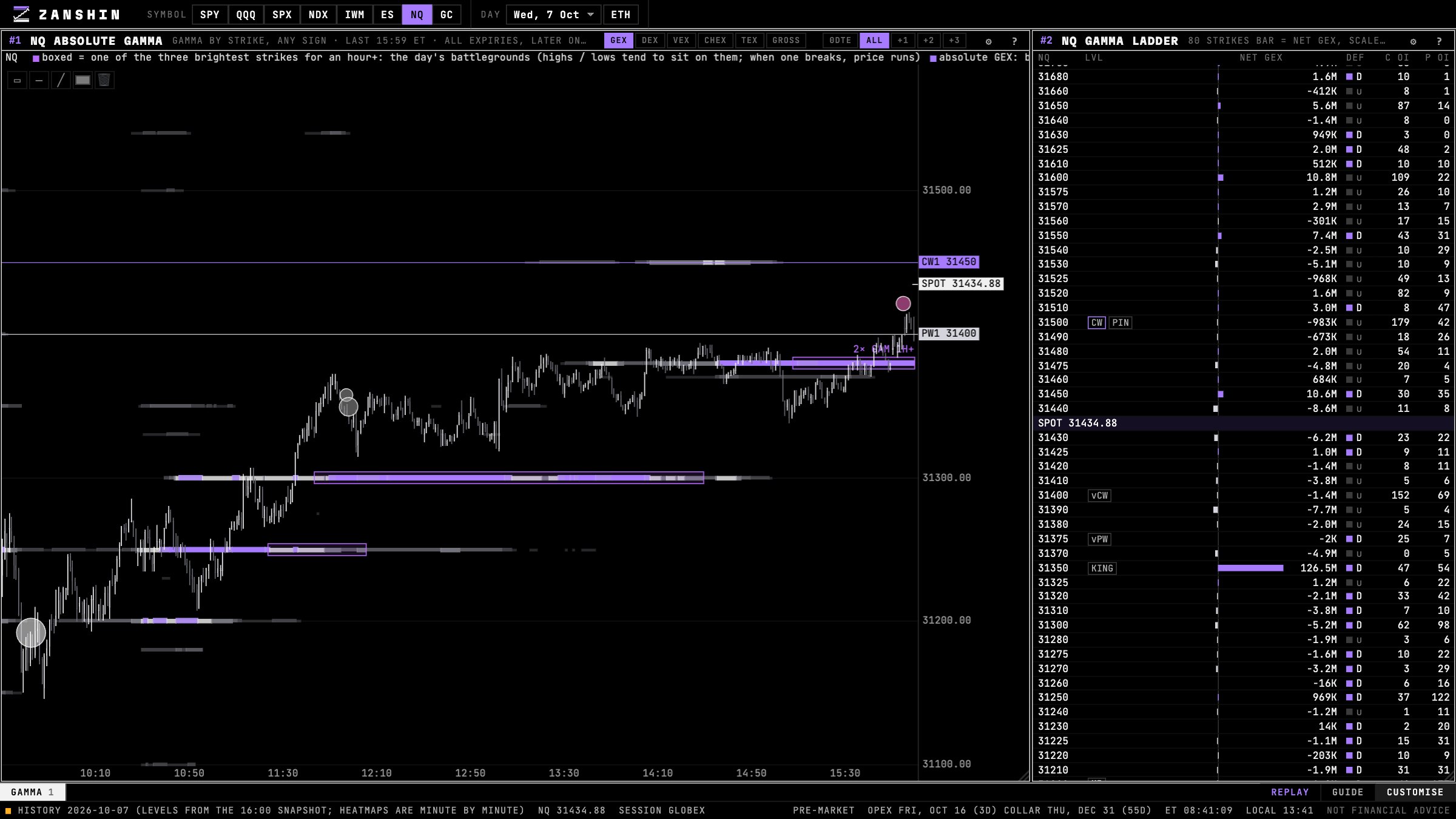
The Spot over Gamma Field window draws each strike's dealer gamma as a horizontal band behind price: purple where dealers are estimated long gamma, grey where they're short, brighter the bigger. It's recomputed every minute from the live chain, so you can watch bands build, fade and move through the session, and replay any archived day.
Questions
Why is gamma highest at the money?
What happens to gamma at expiration?
Is gamma the same for calls and puts?
Not financial advice. This article explains how options and dealer hedging work. It is not a recommendation to buy or sell anything.